
@yoltra/devtools-protocol
Shared protocol types, message definitions, and utilities for the Yoltra DevTools suite.
@yoltra/devtools-protocol is the foundational vocabulary package for the entire DevTools
ecosystem. It defines the wire format, message types, capability negotiation, and JSON Patch
utilities that all other DevTools packages depend on.
#Installation
npm install @yoltra/devtools-protocol#What's Inside
#Protocol Version
A semver string used during handshake negotiation. The hub rejects connections with an incompatible major version.
import { PROTOCOL_VERSION } from "@yoltra/devtools-protocol";

console.log(PROTOCOL_VERSION); // "0.1.0"#Roles
An enum identifying the three participants in the DevTools protocol:
import { DevtoolsRole } from "@yoltra/devtools-protocol";

DevtoolsRole.STORE; // A Yoltra store instance
DevtoolsRole.EXTENSION; // A DevTools UI (browser panel, CLI, VSCode)
DevtoolsRole.HUB; // The central message broker#Message Types
All messages are discriminated on a type field for type-safe routing:
| Direction | Message | Description |
|---|---|---|
| Store → Extensions | STORE_EVENT | Event with JSON Patch delta, committed, and for an event that did not commit, optional reason and vetoedBy |
| Store → Extensions | STATE_SNAPSHOT | Full state tree at a version |
| Store → Extensions | STORE_METRICS | Performance counters |
| Store → Extensions | STORE_SUBSCRIPTIONS | Reducer/effect/middleware inventory |
| Hub → Extensions | STORE_CONNECTED | A store completed handshake |
| Hub → Extensions | STORE_DISCONNECTED | A store disconnected |
| Hub → Extensions | STORE_REGISTRY | Full registry snapshot |
| Extension → Store | REQUEST_STATE | Request a state snapshot |
| Extension → Store | REQUEST_METRICS | Request performance metrics |
| Extension → Store | REQUEST_SUBSCRIPTIONS | Request subscription info |
| Extension → Store | TIME_TRAVEL | Jump store to a specific state |
| Extension → Store | EVENT_REPLAY | Replay events through reducers |
| Extension → Store | EMIT_TO_STORE | Inject a synthetic event |
#Capabilities
Stores, extensions, and the hub advertise capabilities during handshake:
import type { StoreCapabilities, ExtensionCapabilities } from "@yoltra/devtools-protocol";

const storeCaps: StoreCapabilities = {
  replay: true,
  stateSnapshot: true,
  emit: false,
};#JSON Patch Utilities
Convert Yoltra change-detection output into RFC 6902 JSON Patch operations:
import { computePatches, getAtPath } from "@yoltra/devtools-protocol";

const prev = { counter: { value: 1 } };
const next = { counter: { value: 2 } };

const patches = computePatches(prev, next, ["counter.value"]);
// [{ op: "replace", path: "/counter/value", value: 2 }]

getAtPath(next, "counter.value"); // 2#Type-Safe Message Handling
import type { DevtoolsMessage } from "@yoltra/devtools-protocol";

function handle(msg: DevtoolsMessage) {
  switch (msg.type) {
    case "STORE_EVENT":
      console.log("Patches:", msg.patches);
      break;
    case "STATE_SNAPSHOT":
      console.log("State:", msg.state, "v" + msg.version);
      break;
    case "STORE_CONNECTED":
      console.log("Store joined:", msg.store.name);
      break;
    // TypeScript enforces exhaustive handling
  }
}#How the Store Connection Works
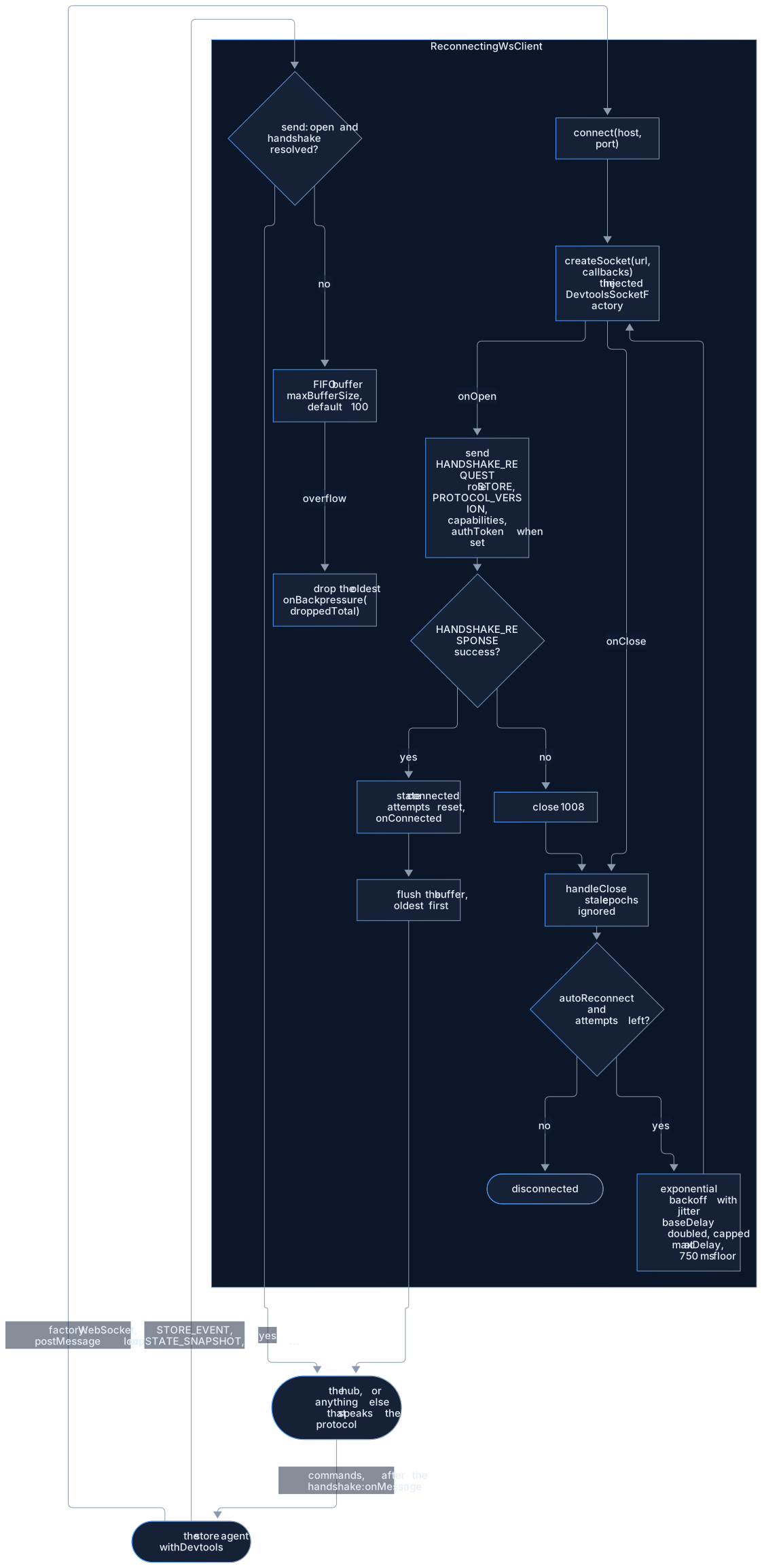
The store agent connects through ReconnectingWsClient, which owns the handshake, the send
buffer and the reconnection loop. The agent only injects the socket as a DevtoolsSocketFactory,
so this package imports no transport. Nothing goes out before a successful HANDSHAKE_RESPONSE:
until then frames wait in a bounded FIFO buffer, and an overflow drops the oldest frame and
reports it through onBackpressure. The panel side (HubProvider in @yoltra/devtools-ui) has
its own connection code and does not use this client.

#Handshake Flow
Client (Store/Extension)              Hub
  │                                     │
  ├─ HANDSHAKE_REQUEST ───────────────► │
  │  { role, protocolVersion, ... }     │
  │                                     │
  │ ◄─────────────── HANDSHAKE_RESPONSE │
  │  { success, negotiatedVersion }     │
  │                                     │
  │  (if store) Hub broadcasts          │
  │  STORE_CONNECTED to all extensions  │
  │                                     │
  │  (if extension) Hub sends           │
  │  STORE_REGISTRY + buffered events   │
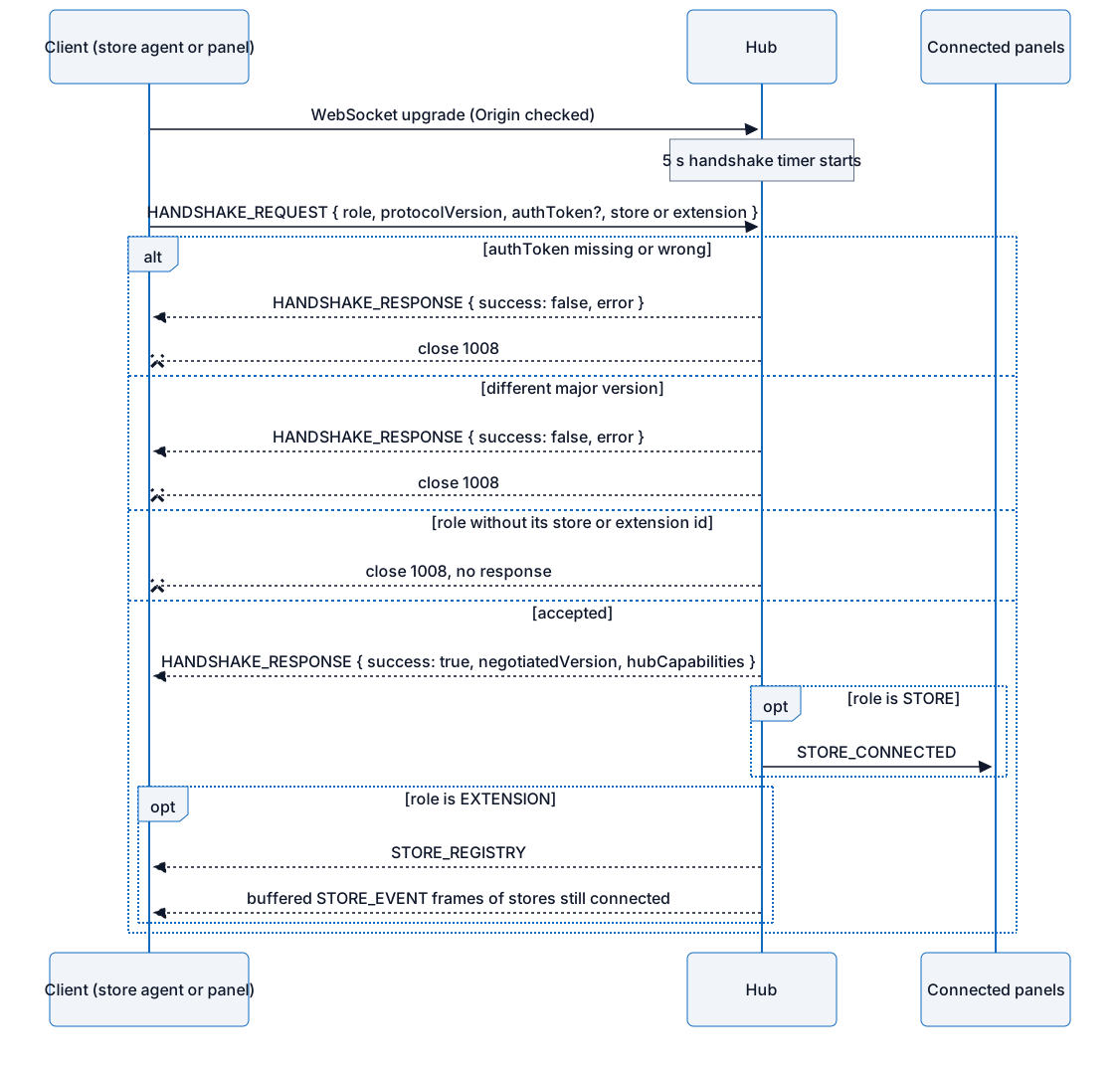
The same exchange with every outcome the hub produces. A client is registered only after the
token, the major version and the role's id all pass; any failure ends with close code 1008, and
so does a client that sends no HANDSHAKE_REQUEST within 5 seconds.

#Technical Docs
TypeDoc auto-generated documentation.
#API Reference
#Constants
| Export | Description |
|---|---|
PROTOCOL_VERSION | Current protocol version string ("0.1.0") |
DevtoolsRole | Enum of protocol participant roles |
#Functions
| Export | Description |
|---|---|
computePatches(prev, next, paths) | Convert changed paths to JSON Patch operations |
getAtPath(obj, dottedPath) | Read a value from an object by dotted path |
#Types
| Export | Description |
|---|---|
DevtoolsMessage | Discriminated union of all message types |
StoreCapabilities | Store capability flags |
ExtensionCapabilities | Extension capability flags |
HubCapabilities | Hub capability flags |
HandshakeRequest | Handshake request payload |
HandshakeResponse | Handshake response payload |
JsonPatch | Single RFC 6902 patch operation |
BaseMessage | Common fields on all messages |
#Related Packages
- @yoltra/devtools-server: WebSocket hub that routes protocol messages
- @yoltra/devtools-browser-agent: Browser store wrapper
- @yoltra/devtools-ui: React hooks for consuming protocol messages
#License
MIT: Free to use in commercial and open-source projects.
Report a problem with this page